Table of Contents
Introduction: The New Dawn of Creative Work
Not long ago, content creation was a slow, grueling process. Writers spent hours digging through search engine results. Designers created each social media graphic individually.. Video editors labored over tiny audio snips for days. Marketers got lost in massive, confusing spreadsheets. This is clear. It is here now. We can see this. It works well.
Now, in late 2026, everything has shifted. We have moved past the initial shock of generative AI. We are no longer debating whether AI is a “fad” or if it will replace writers. Instead, we are living in a reality. AI content creation 2026 is the standard operational backbone for every successful digital brand. Try this now. Do not wait. This is key. It is fast.
This is not a story of machines taking over. It is a story of human creators finding their true voice by handing off the heavy lifting to intelligent systems. The real impact of AI on content creation is that it has cleared away the daily clutter. Today, solo creators, startups, and enterprise teams can produce high-quality, multi-format content at a speed that was once impossible. It is simple. This saves time. It helps you grow. We like this.
But this massive increase in speed has created a new challenge: the sea of sameness. When anyone can press a button. Generate a 1,000-word blog post in seconds, the internet becomes flooded with generic, boring text. If you want your website to stand out, your content must be different. It must have personality, experience, and authority. This is a big deal. We must use it. It is a great tool. This is how.
In this ultimate guide, we will explore the major AI in content creation trends shaping this year. We will analyze how top brands are using these systems, map out a complete tool stack. Show you how to write content that satisfies both search engines and human readers. Let’s dive in. We love this. It is so good. It makes sense. This is the way.
Chapter 1: Competitor Landscape Analysis (Why “Copy-Paste” Content is Dead)
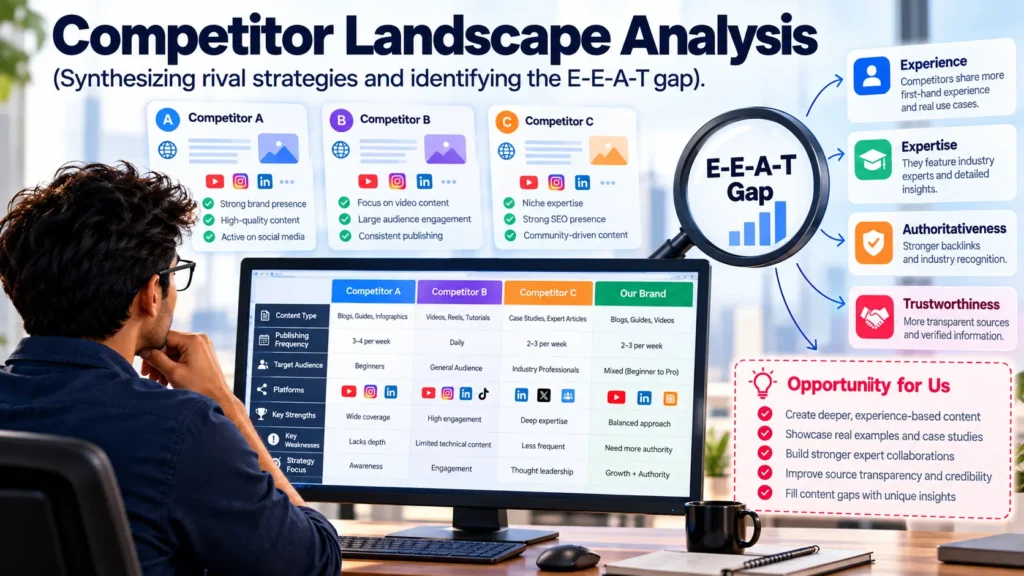
To build a winning plan, we must first look at what is already working. If we analyze the top industry voices who have tackled how AI is transforming content creation, we see four distinct approaches that define the market today: We can win now. You can do it. Let us start. This is clear.
1. The Small Business & Creator Approach (SS Creation)
SS Creation focuses on practical, day-to-day workflow efficiency for small business owners and vloggers. Their core plan is to use AI to clear away “busywork” (like drafting outlines, structuring ideas. Generating video subtitles) while keeping the founder’s personality and local SEO front and center. They warn that “if you let AI do everything, Google and your readers notice. ” It is here now. We can see this. It works well. Try this now.
2. The Strategic & Analytical Vibe (Coherent Market Insights)
Coherent Market Insights approaches the market from an enterprise and smart plan angle. They highlight how AI has moved from a novelty to the backbone of planning, creation, and measurement. They emphasize the rise of smart trend forecasting, instant localization (translating videos. Text for global audiences), and tracking the complete customer journey rather than focusing on “vanity metrics” like clicks or impressions. Do not wait. This is key. It is fast. It is simple.
3. The Technical & Enterprise DXP View (Core DNA)
Core DNA provides the most technical and deep look. They focus on how content management systems (CMS). Digital experience platforms (DXP) integrate with agentic AI workflows. They highlight hyper-personalization (A/B testing vs. dynamic AI-driven content variants), Voice Search Optimization, and Large Language Model Optimization (LLMO). They also touch on using tools like originality. ai to maintain quality. Using LLMs. txt files to index sites for search crawlers. This saves time. It helps you grow. We like this. This is a big deal.
4. The Educational & Growth Angle (DGEM Academy)
DGEM Academy views the landscape through career and skill development. They assert that “if brands neglect AI in 2026, they will vanish.” They emphasize how AI has evened the playing field for startups. Small businesses, enabling them to compete with massive agencies. Their plan focuses heavily on performance marketing, ad copy testing. Rapid cross-platform social media sharing. We must use it. It is a great tool. This is how. We love this.
The Strategic Gap: How You Can Stand Out
While these rivals cover tools. Workflows, they often overlook the practical reality of Zero-Click SEO and the Helpful Content guidelines. To beat your rivals in 2026, you cannot just publish standard AI-written articles. You must create a “Human-in-the-Loop” system that builds deep E-E-A-T (Experience, Expertise, Authoritativeness, and Trustworthiness). It is so good. It makes sense. This is the way. We can win now.
Your goal is not just to rank on search engine results pages (SERPs). Aim to establish yourself as a trusted source for AI search tools like Gemini, ChatGPT Search, and Perplexity. . This is the new frontier of AI content creation 2026. You can do it. Let us start. This is clear. It is here now.
Chapter 2: The Core Trends Transforming Content in 2026
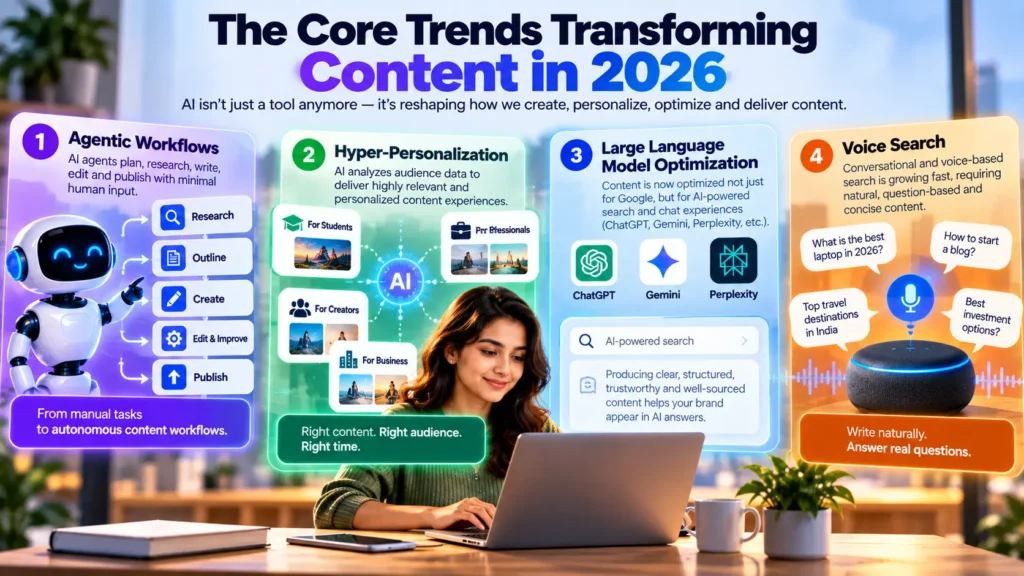
The impact of AI on content creation has evolved far beyond simple draft generation. If you want to stay ahead of the curve, you must understand the four key structural trends that define digital marketing today. We can see this. It works well. Try this now. Do not wait.
Trend 1: Agentic Workflows and Multi-Agent Systems
In 2024, creators used “single-prompt” AI. You entered a prompt, and the AI gave you a response. In 2026, we use agentic workflows. Instead of a single model, we use networks of specialized AI agents. One agent conducts deep research, a second agent builds the SEO structure, a third agent drafts the copy. A fourth agent reviews the content for tone and brand safety. This is key. It is fast. It is simple. This saves time.
These agents can watch, decide, and act within your content platform. For example, some advanced platforms use Model Context Protocol (MCP) servers to connect AI systems directly to database tools, allowing them to pull real-time product data or customer feedback directly into drafts without human intervention. This makes the draft process incredibly accurate and relevant. It helps you grow. We like this. This is a big deal. We must use it.
Trend 2: Hyper-Personalization at Scale
For years, marketers promised personalization but rarely delivered more than a “Hi [First Name]” email. Today, generative AI has made true hyper-personalization a reality. It is a great tool. This is how. We love this. It is so good.
Instead of showing the same blog post or product landing page to every visitor, modern websites adapt in real-time. If a user is a small business owner from India, the website’s layout, case studies. Tone shift to match their context. If the visitor is an enterprise executive from Germany, the content becomes more analytical and technical. This is done by letting AI dynamically adjust content blocks within a composable CMS architecture. It makes sense. This is the way. We can win now. You can do it.
Trend 3: Large Language Model Optimization (LLMO)
SEO is no longer just about optimizing for Google’s search crawlers. Today, we must optimize for how large language models interpret meaning, context, and brand authority. This is known as Large Language Model Optimization (LLMO) or Answer Engine Optimization (AEO). Let us start. This is clear. It is here now. We can see this.
When a user asks Perplexity or Gemini “What is the best content management system for AI personalization? “, those systems do not return a list of links. They write a conversational answer and cite their sources. If your brand is not structured in a way that AI models can easily read. Cite, you do not exist in their world. This means publishing highly structured data, clear schema markups. Maintaining clean plain-text indexes like llms. txt files on your server. It works well. Try this now. Do not wait. This is key.
Trend 4: Voice Search and Conversational Queries
With the rise of smart assistant headphones, voice-activated glasses. Conversational AI interfaces, search queries have become much longer and more conversational. People no longer type “AI marketing trends. ” Instead, they ask, “How is AI transforming content creation for small businesses this year? ” It is fast. It is simple. This saves time. It helps you grow.
Your content structure must mirror this change. We must write in a conversational, question-and-answer format that directly addresses the complex, long-tail queries that voice search tools prioritize. We like this. This is a big deal. We must use it. It is a great tool.
Chapter 3: The Multi-Format Content Ecosystem (The Death of Single-Format Blogging)
One of the most important AI in content creation trends is the shift toward multi-format sharing. In 2026, writing a blog post. Leaving it on your website is a recipe for failure. Audiences consume content across YouTube, TikTok, Instagram, LinkedIn, newsletters, and podcasts. This is how. We love this. It is so good. It makes sense.
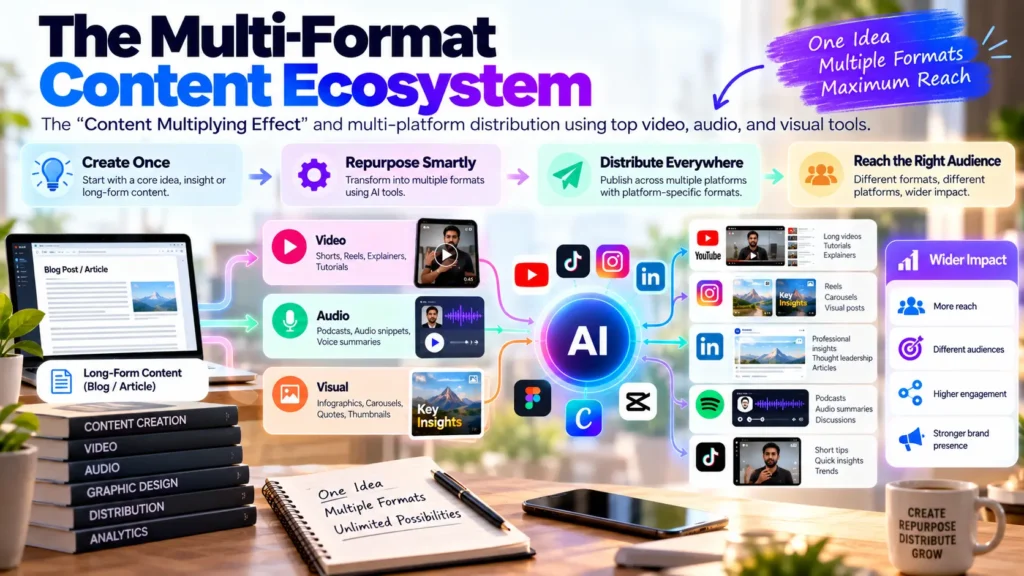
To survive, you must turn every single piece of content into a multi-format ecosystem. This is known as the content multiplying effect. AI tools make this process fast and cheap. This is the way. We can win now. You can do it. Let us start.
[ Core Long-Form Blog Post ]
|
+———————-+———————-+
| | |
[Short Video Script] [Live Visual] [Audio Podcast]
| | |
(TikTok, YouTube Shorts) (Canva, Infographics) (ElevenLabs Voiceover)
1. From Text to Video Scripts and Social Shorts
Using AI, your written blog post can be transformed into a video script in seconds. Tools like Pictory or HeyGen can take your written paragraphs. Generate a highly engaging, visual video with realistic AI avatars presenting the material. This is clear. It is here now. We can see this. It works well.
If your team is camera-shy, you can use these avatars to present entire courses or webinars. This allows you to scale your video presence across YouTube. TikTok without needing expensive camera crews or studio rentals. Try this now. Do not wait. This is key. It is fast.
2. Streamlined Audio and Voiceovers
Getting high-quality voice narration once required expensive microphones, quiet recording booths, and professional voice actors. Now, AI voice generators like ElevenLabs, Murf AI. Speechify can create realistic, natural-sounding voiceovers in minutes. It is simple. This saves time. It helps you grow. We like this.
You can instantly translate your audio into dozens of languages, allowing you to reach a global audience with a single click. This level of localization was once restricted to massive enterprise budgets. Now it is accessible to everyone. This is a big deal. We must use it. It is a great tool. This is how.
3. Rapid Graphic Design and Infographics
Nobody has to stare at a blank canvas anymore. AI design tools like Canva’s Magic Studio, Adobe Firefly. Midjourney allow you to turn complex ideas into gorgeous, eye-catching graphics. We love this. It is so good. It makes sense. This is the way.
If you want to explain a complex data set, you can prompt the AI to generate an infographic. This not only makes your blog post more visually appealing. Also increases the time readers spend on your page. Is a key signal for search engine rankings. We can win now. You can do it. Let us start. This is clear.
Chapter 4: The 2026 Content Stack (Ranked & Compared)
To build a high-performance content engine, you need the right tools. Here is a deep comparison of the top AI tools across five key categories, ranked by their effectiveness, ease of use, and cost. It is here now. We can see this. It works well. Try this now.
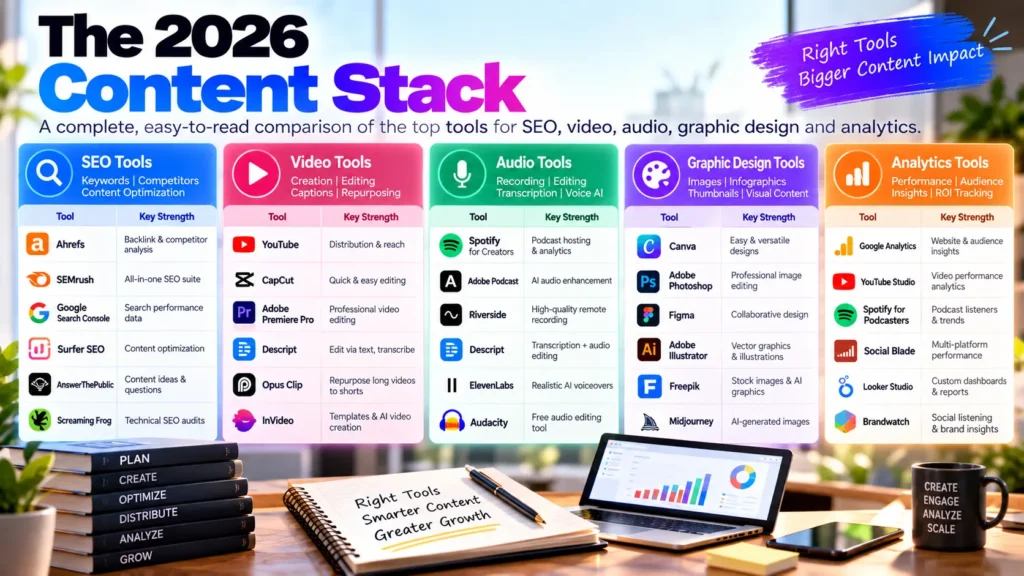
1. Writing & SEO Optimization Tools
These tools help you research search engine results pages (SERPs), analyze search intent, cluster topics, and draft optimized copy.
| Tool Name | Key Features | Best Used For | Learning Curve |
| SurferSEO | Real-time SEO suggestions, competitor analysis, topic clustering. | SEO-optimized blog writing | Moderate |
| Neuron Writer | Semantic keyword optimization, outline planning, competitor tracking. | Writing long-form articles | Easy |
| Writesonic | Fast draft generation, headline testing, product descriptions. | High-volume content drafting | Very Easy |
| MarketMuse | Deep content audits, topical authority mapping, gap analysis. | Enterprise content plan | Complex |
2. Video & Visual Production Tools
These tools automate video editing, subtitle generation, and avatar-led video creation.
| Tool Name | Key Features | Best Used For | Learning Curve |
| HeyGen | Realistic AI avatars, voice cloning, multi-language translation. | Faceless YouTube & course creation | Moderate |
| Pictory | Quickly turns text scripts or blog posts into short videos. | Video repurposing | Easy |
| Veed.io | Automated subtitle generation, background noise removal, video editing. | Quick social media edits | Easy |
| Revid.ai | Generates trending vertical shorts from text prompts in seconds. | TikTok & Reels scaling | Very Easy |
3. Audio & Voice Generation Tools
These systems create natural-sounding narration and translate audio files instantly.
| Tool Name | Key Features | Best Used For | Learning Curve |
| ElevenLabs | Ultra-realistic voice cloning, emotive speech, multi-lingual audio. | High-quality narration & podcasts | Easy |
| Murf AI | Professional studio-grade voiceovers, timing control, presentation audio. | Corporate videos & training | Moderate |
| Speechify | Fast text-to-speech reading, natural voices, document reading. | Audio ease | Very Easy |
4. Graphic & Visual Design Tools
These platforms generate images, banners, layouts, and custom marketing designs.
| Tool Name | Key Features | Best Used For | Learning Curve |
| Midjourney (v6) | Photorealistic images, best detail, creative textures. | High-end blog banners & custom art | Complex |
| Adobe Firefly | Safe-for-work commercial designs, generative fill, vector expansion. | Professional marketing assets | Moderate |
| Canva Magic Studio | One-click background removal, text-to-image, presentation builder. | Rapid social media graphics | Easy |
5. Plan & Analytics Tools
These systems help you analyze audience behavior, predict performance, and spy on rivals.
| Tool Name | Key Features | Best Used For | Learning Curve |
| Google Analytics 4 | Smart audience metrics, custom user journey tracking. | Measuring user engagement | Complex |
| SimilarWeb | Competitor traffic insights, search engine share tracking. | Identifying market gaps | Moderate |
| Crayon | Competitor intelligence tracking, message monitoring. | Tracking competitor plans | Complex |
Chapter 5: Designing an E-E-A-T Compliant Editorial Plan
The absolute biggest mistake you can make when writing about how AI is transforming content creation is relying purely on automated drafts. If a search engine crawler or a human reader encounters an article that reads like a generic regurgitation of Wikipedia, they will leave immediately. Do not wait. This is key. It is fast. It is simple.
To prevent this, you must build your entire editorial plan around Google’s E-E-A-T guidelines: Experience, Expertise, Authoritativeness, and Trustworthiness. Here is how to do it. This saves time. It helps you grow. We like this. This is a big deal.
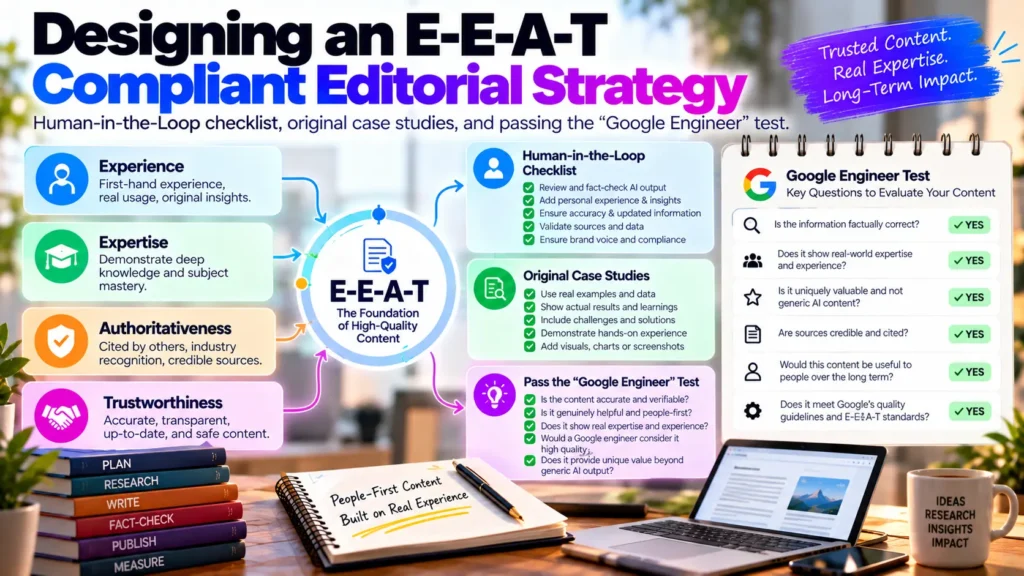
1. Highlight Real-World Experience (The “First-Person” Angle)
Google’s Helpful Content system heavily weights original, first-person experience. This means your content must contain insights that an AI model cannot invent. We must use it. It is a great tool. This is how. We love this.
- Share Personal Case Studies: Use phrases like “In our testing of these three tools, we discovered that…” or “Our website traffic grew by 42% when we shifted to…”
- Include Real Data: Show screenshots, charts, or spreadsheet exports of your own results.
- Discuss Your Failures: Share what did not work. AI models rarely write about failure; doing so makes your brand feel incredibly human and trustworthy.
2. Demonstrate True Expertise
Your readers want to know that the content was written or reviewed by an expert.
- Include Expert Quotes: Reach out to industry professionals and weave their opinions into your sections.
- Write Detailed Author Bylines: Do not publish under “Admin.” Create an author profile that showcases your years of experience, certifications, and past successes.
- Cite Authoritative Sources: Link out to reputable research papers, government reports, or certified studies to back up your claims.
3. Build Authority and Trust
Trustworthiness is the most important part of the E-E-A-T framework.
- The “Google Engineer” Test: As the CEO of Core DNA, Sam Saltis, suggests: ask yourself, “If a Google search engineer was looking over your shoulder, would you still post this?” If the answer is no, do not publish it.
- Maintain Fact Sheets: Ensure all statistics are accurate and linked directly to their primary sources.
- Keep a Clear Corrections Policy: Let readers know how you verify facts and how they can report errors.
Avoiding the “Sea of Sameness”
The following checklist will help you transform a generic AI draft into an E-E-A-T powerhouse:
- [ ] First-Person Voice: Does the article use “I” or “We” to show real experience?
- [ ] Proprietary Data: Are there unique data points or charts that cannot be found elsewhere?
- [ ] Expert Opinions: Did you include quotes or insights from industry experts?
- [ ] Fact Verification: Have all numbers, dates, and percentages been verified against primary documents?
- [ ] Actionable Takeaways: Does the reader get a clear, step-by-step framework they can use immediately?
Chapter 6: Practical SEO Prompts for 2026 Content Creation
To help you put these plans into action, here are three highly optimized, advanced prompts you can use with your AI systems to research, structure, and refine your content.
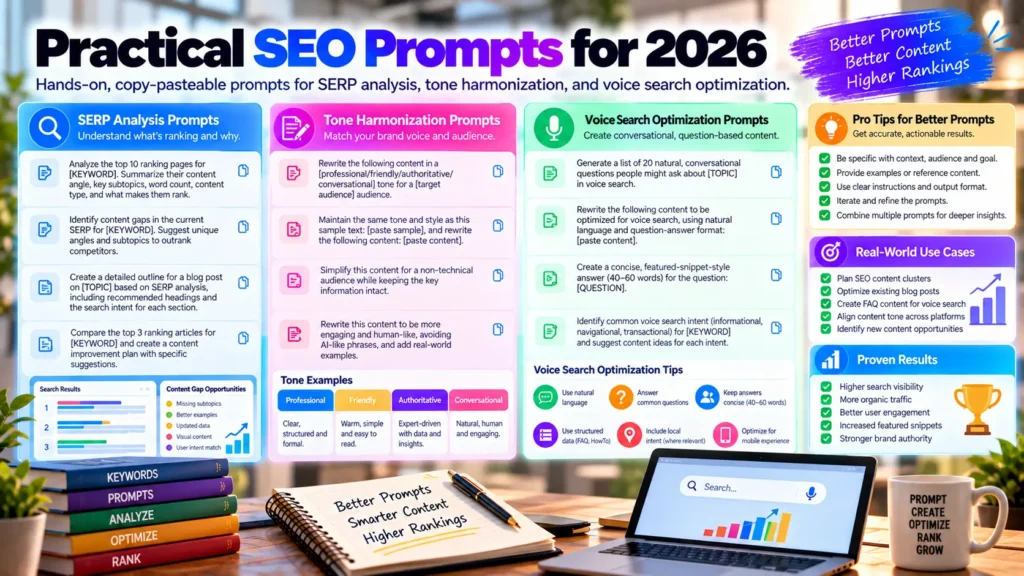
Prompt 1: The SERP Researcher & Intent Analyzer
This prompt forces your AI to act like an expert SEO strategist, researching search results and mapping intent before writing.
Act as an elite SEO Strategist. Analyze the top 10 search results for the keyword “[Your Primary Keyword]”. Identify the search intent (informational, transactional, navigational, commercial). Map out the core subtopics, common headings (H2s. H3s), and questions that rivals are answering. Highlight the content gaps where rivals have provided thin or generic explanations. Generate a detailed, unique article outline that addresses these gaps, prioritizes user intent. Ensures our content is twice as valuable as the current top-ranking pages. Do not write the article yet; only output the analysis and the structural outline. It is so good. It makes sense. This is the way. We can win now.
Prompt 2: The E-E-A-T Tone and Brand-Voice Harmonizer
Use this prompt to inject your personal experience. Brand voice into a rough AI-generated draft. You can do it. Let us start. This is clear. It is here now.
Act as a master editor and brand strategist. I will provide you with a rough draft of an article. A list of my personal experiences, data points, and opinions on the topic. Your job is to rewrite the draft to seamlessly integrate my first-person experiences, case studies, and unique opinions. The tone must remain highly professional, authoritative. Engaging, but it must read like a human expert wrote it. Ensure that every section has a readability score above 65 (Flesch Reading Ease), using clear, active-voice sentences and avoiding dense corporate jargon. We can see this. It works well. Try this now. Do not wait.
Prompt 3: The LLM and Voice Search Optimizer
This prompt optimizes your content so that conversational AI search tools (like Perplexity. ChatGPT Search) can easily understand and cite your site. This is key. It is fast. It is simple. This saves time.
Act as an Answer Engine Optimization (AEO) expert. Review this completed article and identify the top 5 questions that voice-search users or conversational AI users are likely to ask about this topic. For each question, draft a clear, concise, 2-3 sentence “Direct Answer Block” that can be easily displayed in an AI search overview. Format these blocks using clear schema-friendly headers (H3). Bold the key terms so that Large Language Models (LLMs) can easily parse, index. Cite our brand as the definitive source. It helps you grow. We like this. This is a big deal. We must use it.
Chapter 7: Composable CMS & Headless DXP: The Operational Engine
Creating great content is only half the battle. If your website is slow, rigid, or incapable of personalization, your content plan will fail. It is a great tool. This is how. We love this. It is so good.
In late 2026, standard static content management systems are struggling to keep up. Enterprise teams are shifting toward Composable CMS and Headless Digital Experience Platforms (DXPs). Here is why this architecture is essential for your AI content creation 2026 workflow. It makes sense. This is the way. We can win now. You can do it.
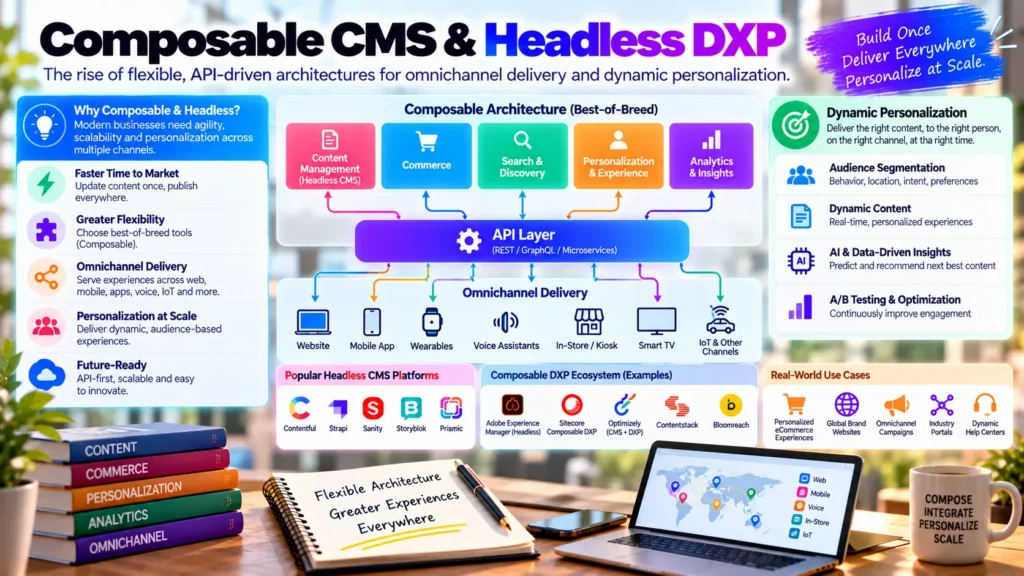
1. Composable Architecture for AI Ecosystems
A composable CMS does not lock you into a single system. Instead, it allows you to connect different tools using APIs. You can easily integrate your writing assistants, SEO auditors, translation engines. Analytics trackers directly into your content workspace. Let us start. This is clear. It is here now. We can see this.
This means your writers never have to leave the CMS to optimize a headline or translate a post. It creates a smooth, frictionless workspace that speeds up production times. It works well. Try this now. Do not wait. This is key.
2. Headless Delivery for Omnichannel Brand Unity
Today’s audiences do not just browse websites on desktop computers. They read newsletters, browse mobile apps, watch smart-screen videos, and listen to voice assistants. It is fast. It is simple. This saves time. It helps you grow.
A headless CMS separates the content creation workspace (the “backend”) from. The content is displayed (the “frontend”). This allows you to write a blog post once. Deploy it everywhere instantly—from your primary website to a mobile app, an e-commerce storefront, or a digital billboard. This ensures total brand unity across every single touchpoint. We like this. This is a big deal. We must use it. It is a great tool.
[ Composable CMS Core Hub ]
|
+————————+————————+
| | |
[API: Desktop Site] [API: Mobile App] [API: Email Newsletter]
3. Real-Time Analytics and Smart Scheduling
A modern DXP platform tracks exactly how users interact with your content. It goes beyond simple click counts to track how someone moves from their first read to their final purchase. This is how. We love this. It is so good. It makes sense.
By integrating smart analytics into your CMS, you can automate your content schedule. The system analyzes your historical traffic data. Quickly publishes and shares your content at the precise moment your audience is most active and receptive. This level of data-driven scheduling takes the guesswork out of sharing. This is the way. We can win now. You can do it. Let us start.
Chapter 8: Conclusion and Actionable 2026 Checklist
The era of AI content creation 2026 is not about replacing human creativity; it is about supercharging it. By automating repetitive daily tasks, AI has cleared the noise. You can focus on what truly matters: telling stories that connect with real people. This is clear. It is here now. We can see this. It works well.
The brands that succeed in this new landscape are those that find the perfect balance. They use AI for its speed, scale. Structure, but they rely on human experience, judgment. Passion to give their content a heartbeat. Try this now. Do not wait. This is key. It is fast.
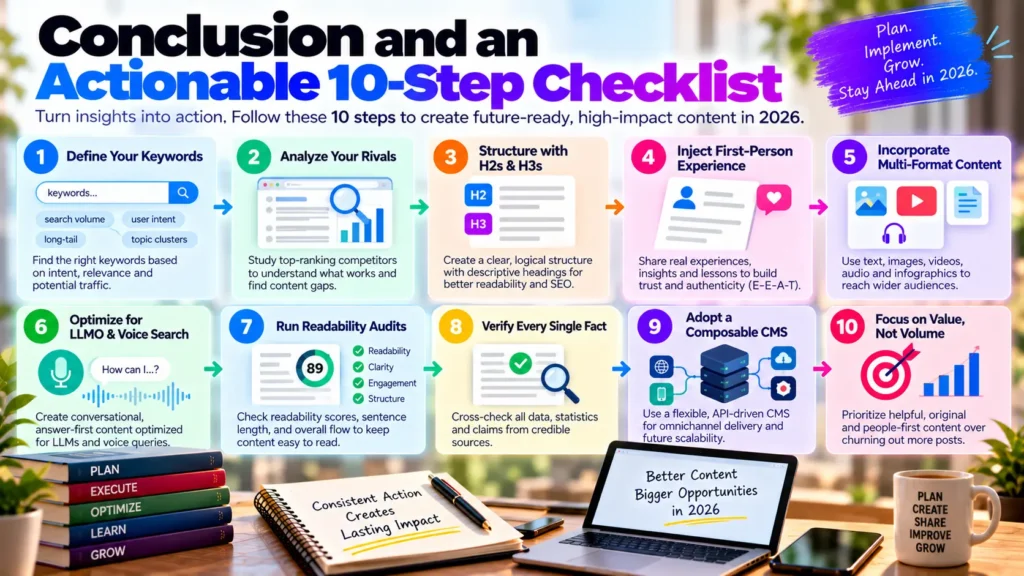
Your 10-Step Actionable Content Checklist
- [ ] Define Your Keywords: Ensure your primary keyword (AI content creation 2026). Secondary keywords are naturally integrated into your headers and text. It is simple. This saves time. It helps you grow. We like this.
- [ ] Analyze Your Rivals: Research what is ranking in your niche. Identify topics or questions they have ignored. This is a big deal. We must use it. It is a great tool. This is how.
- [ ] Structure with H2s & H3s: Organize your post with clear, descriptive headers to help search engine crawlers. AI models parse your content. We love this. It is so good. It makes sense. This is the way.
- [ ] Inject First-Person Experience: Weave personal case studies, data points, or opinions into every major section. We can win now. You can do it. Let us start. This is clear.
- [ ] Incorporate Multi-Format Content: Turn your written draft into a short video script, an audio voiceover, or a social media infographic. It is here now. We can see this. It works well. Try this now.
- [ ] Optimize for LLMO & Voice Search: Include clear, concise question-and-answer blocks for conversational search engines. Do not wait. This is key. It is fast. It is simple.
- [ ] Run Readability Audits: Keep your sentences active. Punchy to maintain a Flesch Reading Ease score above 65. This saves time. It helps you grow. We like this. This is a big deal.
- [ ] Verify Every Single Fact: Check all dates, statistics. Citations against reputable, primary sources to build authority. We must use it. It is a great tool. This is how. We love this.
- [ ] Adopt a Composable CMS: Ensure your publishing platform can easily connect with advanced AI tools via APIs. It is so good. It makes sense. This is the way. We can win now.
- [ ] Focus on Value, Not Volume: Do not flood your website with thin, automated drafts. Focus on creating fewer, higher-quality assets that truly help your audience. You can do it. Let us start. This is clear. It is here now.
1. Will AI replace human content creators in 2026?
No. AI is not replacing human creators; rather, it is clearing away repetitive, time-consuming tasks—such as keyword research, formatting, video editing, drafting, and scheduling—so humans can focus on strategy, storytelling, empathy, and creative decision-making. Industry statistics reveal that 94% of marketers plan to use AI in their content creation, leveraging it as a productivity booster rather than a human replacement
2. Can AI-generated blog posts rank high on Google?
Yes. AI-assisted content can rank very well on search engines, provided it is accurate, valuable, original, and directly satisfies user search intent. However, blindly copy-pasting raw AI drafts carries real risks: readers and search engines quickly spot generic, unedited text. To maintain high rankings and avoid penalties, creators must edit AI outputs and inject unique insights, proprietary data, or personal brand voice
3. What are the biggest advantages of using AI for content creation?
The primary benefit of AI is massive time savings without sacrificing quality. Key advantages include:
Rapid Research & Planning: Summarizing large datasets, analyzing SERP intent, and spotting competitor content gaps in seconds.
Multi-Format Creation: Generating blog drafts, social media hooks, video scripts, and visual thumbnails at high speed.
Cost Efficiency: Evening the playing field for small businesses and solo creators who cannot afford large production teams or agencies.
Hyper-Personalization: Tailoring messaging and recommendations based on real-time user behavior
4. How is AI transforming video, voice, and graphic design creation?
AI has dismantled traditional production bottlenecks across all digital formats:
Video & Shorts: Tools like HeyGen, Pictory, Veed, and Revid generate social shorts, scripts, and videos featuring realistic AI avatars and automated closed captions—eliminating the need for camera crews or studios.
Realistic Voiceovers: Voice generators such as ElevenLabs, Speechify, Murf AI, and PlayHT create studio-quality narration in dozens of languages without specialized recording equipment.
Graphic Design: AI image generators like Canva AI, Adobe Firefly, Midjourney, and DALL-E 3 instantly generate custom social graphics, blog banners, and visual layouts
5. How does AI enhance SEO and search optimization?
Beyond simple keyword placement, AI tools (such as SEMrush, Ahrefs, SurferSEO, and NeuronWriter) analyze top-ranking SERP results, build comprehensive topic clusters, optimize headings and meta descriptions, and structure internal links. Additionally, AI helps brands adapt content for conversational queries and voice search interfaces
7. How can creators stand out in an AI-dominated landscape?
The most successful creators adopt a Human-in-the-Loop approach. They delegate the heavy lifting (outlines, research, repetitive edits) to AI while retaining full ownership over storytelling, personal experiences, original opinions, and relationship building
Want to explore the business impact of SEO first? Read our previous guide, “How SEO Helps Small Businesses Get More Customers,” to learn how SEO can help small businesses increase visibility, reach potential customers, and grow online.